Diamond Version 4 Preview
After several years of announcements, the long expected version 4 of Diamond, our software for
crystal and molecular structure visualization, has been released on October 28, 2014.
This page gives you an overview of the new features of Diamond version 4.
Please note that some functions will be (or have been) released in later minor updates 4.1, 4.2 etc. These
minor updates are free-of-charge for customers of Diamond 4.0,
4.1, etc.
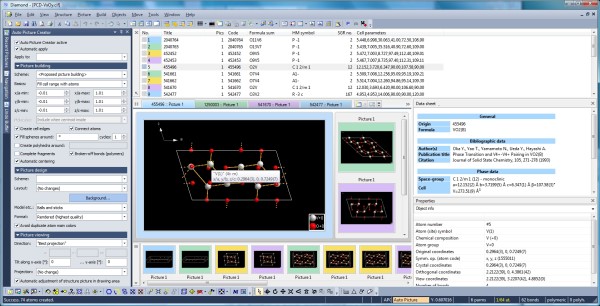
Screen shot of version 4 beta 1 (Full size image: 644 KB)
Automatic and batch structure picture creation:
• "Auto Picture Creator" docking pane automatically applies changes in
building options, picture design and viewing direction directly to the structure picture.
• Definition and application of "design schemes" (style sheets).
• Enhanced automatic structure picture creation.
• "Building schemes" (in Diamond 3 called "Auto-Build") and "Picture Creation
Assistant" extended for packing diagram, and contact and H-bond options.
Enhanced productivity:
• New ("Grab") mode for more intuitive rotation, shifting or zooming during exploration of a crystal or molecular structure.
• Neighbouring preview of atoms and molecules around the atom (bond, molecule)
under mouse cursor.
• Several options to use the mouse wheel to change properties (enlargement factor, zoom in/out, change
atom radii) or to change surroundings (blow up polyhedra, expand molecule cluster, etc.).
• Improved evaluation of bonding spheres (connectivity).
• Determination of atom site environments basing upon Dirichlet domains (Voronoi
polyhedra).
• Acceleration of structure picture drawing. Anti-aliasing (version 4.1).
• Improved selection of objects from the structure picture (additive/subtractive
selection). Selection filter (version 4.1).
Extended functionality for molecules and polymers:
• Use several options to create a packing diagram: cell range, sphere, slab, or
slice of molecules.
• Non-bonding contacts and improved handling of H-bonds.
• Connection parameters, usually imported from "_geom_bond_xxx", "_geom_contact_xxx",
and "_geom_hbond_xxx" loops in CIF.
• Improved functions to complete molecular fragments, new function to generate (symmetry-equivalent) molecules.
• Search for molecules in the neighbourhood of an atom or molecule. (Version 4.1)
• Expand or reduce clusters of molecules.
• Grow or cut molecular fragments or polymers step-by-step sphere by sphere.
• Pump up or shrink multiple coordination spheres around selected atoms (especially
for polymers).
New polyhedron functions:
• Atomic environment as new optional criterion to define the coordination
polyhedron's atoms.
• Enhanced construction from atoms or bonds (version 4.1).
• Combination or splitting of polyhedron faces by clicking. (Version 4.1)
• Copy and paste of polyhedra between atoms of same site. (Version 4.1)
• Creation of Voronoi polyhedra.
Searching for structure data:
• Access to the crystal structure database
COD ("Crystallography Open Database") including (amongst
others) AMCSD ("American Mineralogist Crystal Structure
Database") as well as CIF files from the IUCr
journals.
• Small database of most frequent (inorganic) structure types, e.g. for "New Structure"
function. (Version 4.1)
• Improved searching of Diamond documents and structure files on your hard disk.
Improved user interface:
• Better integration and correlation of the different views (structure picture,
tables, powder pattern, etc.).
• Editing of a structure picture side-by-side with the other pictures' thumbnails
in a multiple picture document.
• Enhanced possibilities to preview, resize, and arrange structure picture thumbnails.
• Color coding of structural parameter sets.
• "Recent pictures": List or thumbnails of the latest viewed and/or edited structure pictures.
• Undo/Redo can be done now with multiple steps together, assisted by thumbnail
pictures of the previous conditions.
• Full screen view of structure picture.
• Powder pattern, data sheet (brief or comprehensive),
and distances table beneath structure picture graphics with enhanced correlation
possibilities (e.g. distances around atoms currently selected in structure pictures).
• "Atom list": Hierarchical list of atom groups, atom sites, and created atoms of structure picture,
e.g. to edit properties and designs or to select from.
• New tables for created molecules (or fragments) as well as for bond,
H-bond, and contact parameters.
• Atomic parameters dialog with report-like representation of atoms (which
can be grouped for sites), with items that can be edited directly in the report.
More new features to come in minor updates 4.x:
• Start page with news channel and thumbnails of recently viewed structure pictures.
• More design properties of atoms and bonds. Atom design can be assigned to individual
sites.
• Improved recording of structure pictures to create video sequences from.
• Animated POV-Ray pictures or video sequences from POV-Ray pictures.
• User-defined symmetry. Visualization of symmetry elements.
• Bond valences.
• Optional calculation of powder pattern using Debye formula basing upon the atoms
currently present in the structure picture.
How to update to version 4
Customers who have purchased the previous version 3.x after August 1, 2010 will be entitled to update to version 4 free-of-charge. Customers who have already been
using the current version before will be offered an update to the new version at
significantly reduced price. Changes and bug fixes to be made in version 4.x will
be free-of-charge for customers who purchase version 4.0 or higher.
|

 Search
